Last updated July 15, 2026
The Complete Guide to Gate Repair in Las Vegas
A gate operator that lasts 12 years in Seattle can fail in 4 in Las Vegas — not because it’s cheap, but because nobody warned the installer about 115°F motor compartment temperatures, caliche-locked posts, and haboob dust infiltrating every moving part. Las Vegas does things to gate systems that no other market replicates, and most gate repair advice online was written by people who have never pulled a failed capacitor out of a sun-baked LiftMaster in August. This Gate Repair guide fixes that. By the time you finish reading, you’ll know exactly what’s killing your gate, what a fair repair looks like, and how to stop the same failure from happening again.
Quick Answer
Gate repair in Las Vegas covers swing gates, slide gates, and bi-fold systems experiencing motor failure, post lean, wiring faults, access control errors, and heat-degraded components. Most repairs are completable in a single visit when a technician carries parts and can weld on-site. Las Vegas’s extreme desert climate — sustained heat above 110°F, caliche soil, and seasonal dust storms — accelerates component wear significantly faster than national averages, so repair timelines and part-replacement frequencies here don’t match what you’ll read in generic guides.
Table of Contents
- How Desert Heat Destroys Gate Components Faster Than You Think
- Caliche Soil, Post Lean, and Foundation Heave: A Las Vegas-Specific Problem
- Gate Types and Their Most Common Failure Modes in Las Vegas
- Repair-First vs. Replace-First: How to Tell Which Diagnosis You’re Getting
- What Multi-Brand Experience Actually Means on a Service Call
- Gate Access Control in Las Vegas: What Breaks and Why
- What Gate Repair Costs in Las Vegas
- A Desert-Specific Maintenance Schedule That Keeps Gates Running
How Desert Heat Destroys Gate Components Faster Than You Think
Most gate operators are rated for ambient temperatures up to around 105°F. Las Vegas regularly sits at 115°F in July and August — and that’s the air temperature. Inside a black powder-coated motor housing sitting on sun-baked concrete in Summerlin or Henderson, actual component temperatures can exceed 140°F. That gap between the rated spec and the real operating condition is where gate systems fall apart.
Here’s what degrades first and how fast:
- Capacitors: The run capacitor is essentially the engine-starter for your gate motor. In moderate climates, a quality capacitor lasts 7–10 years. In Las Vegas’s heat, we routinely see them fail in 3–5 years. A swollen or leaking capacitor is the single most common cause of a gate motor that hums but won’t move — and it’s a $40–$90 part, not a reason to replace the whole operator.
- Rubber seals and gaskets: Conduit entry seals, motor housing gaskets, and limit switch rubber components crack and shrink under UV exposure and heat cycling. Once a seal fails, dust and fine desert grit enter the control board housing. On a DoorKing or FAAC system, that contamination causes intermittent faults that are maddening to diagnose if you don’t already know what caused them.
- Photocell lenses: The infrared safety sensors on either side of your driveway gate opening are protected by small plastic lenses. UV radiation in the Mojave fogs those lenses over time, causing phantom obstructions — your gate reverses for no visible reason. Cleaning the lenses restores function; replacing the pair costs $60–$120. This is frequently misdiagnosed as a control board fault.
- Lubricants: Standard chain lubricants and grease formulations thin out and migrate off bearing surfaces above 120°F. A chain drive that’s properly lubricated in March can be running metal-on-metal by July. High-temperature synthetic lubricants rated above 300°F are the only appropriate choice for Las Vegas gate applications.
- Battery backup systems: Lead-acid backup batteries — standard on most Viking, Ghost Controls, and Mighty Mule residential operators — have a rated cycle life that assumes reasonable temperatures. In Las Vegas, expect 18–24 months of real service life, not the 3–5 years you’d see in a cooler market.
The fix isn’t always replacing the operator. It’s understanding which part of the system the heat attacked first, and addressing that specifically.
Caliche Soil, Post Lean, and Foundation Heave: A Las Vegas-Specific Problem
Caliche is a calcified, cement-like layer of soil that forms naturally across the Mojave desert floor. It’s found at varying depths throughout Las Vegas — sometimes 6 inches down, sometimes 3 feet. For gate posts, caliche creates two competing problems that most out-of-state guides never mention.
Problem one: inadequate initial depth. When a gate installer hits a caliche layer during post installation, the temptation is to stop digging and pour concrete on top of it. The result is a post footing that’s too shallow — often only 18–24 inches when Las Vegas soil conditions really call for 36–42 inches of embedment. A shallow footing in sandy soil above caliche shifts. Over two to four years, posts lean. A leaning post changes the geometry of the entire gate system: swing gates bind at the latch, slide gates derail from their tracks, and the motor fights increased resistance every cycle.
Problem two: heave from water intrusion below caliche. In neighborhoods like Centennial Hills and the areas around the 215 corridor, irrigation water and occasional flash-flood saturation can pool beneath a caliche layer, creating hydrostatic pressure that lifts the layer — and anything embedded in it — upward. We’ve documented post rises of nearly an inch over a single wet winter in northwest Las Vegas, enough to jam a gate completely.
The correct repair for a leaning post is redigging and resetting with proper depth and drainage-rated concrete mix — not shimming or bracing. Shimming a post with wooden wedges or steel plates is a temporary cosmetic fix that fails within one summer. If a technician quotes you a shim-and-brace repair for a post lean problem, get a second opinion.
Gate Types and Their Most Common Failure Modes in Las Vegas
Not all gate failures are created equal. The type of gate you have determines which parts wear first and what a realistic repair involves.
Swing Gates
Swing gates are the most common residential gate type in Las Vegas, especially in master-planned communities across the southwest valley. The most frequent failure points are:
- Hinge wear and sag, accelerated by the weight of steel gates expanding and contracting through 80°F daily temperature swings
- Linear actuator rod seal failure, allowing heat and grit into the ram cylinder
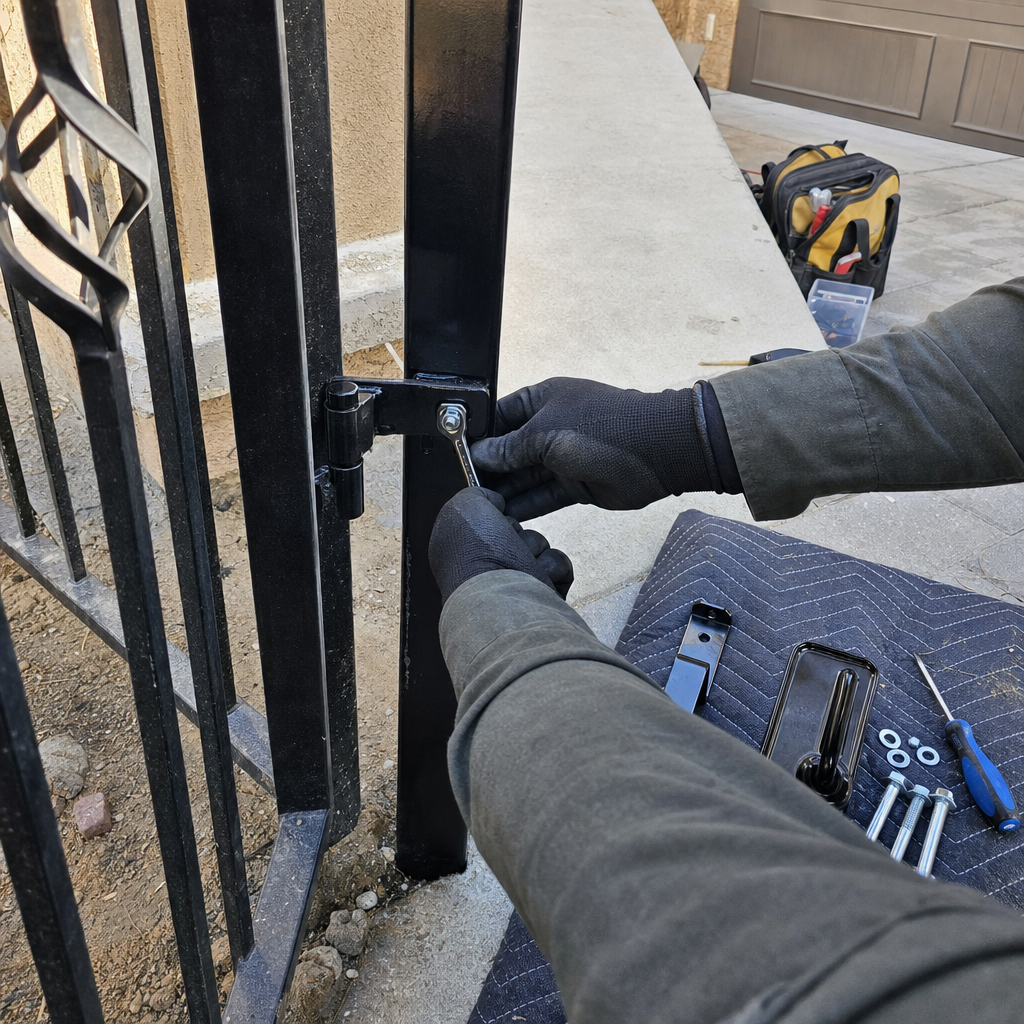
- Weld joint cracking at the hinge plate, especially on older ornamental iron gates where the original weld bead was undersized
- Limit switch drift — the gate overshoots or undershoots its open/close position as components expand in heat
Slide (Rolling) Gates
Slide gates are common on commercial properties, multi-unit residential communities, and larger residential lots in areas like Lone Mountain and Aliante. Their failure signatures in Las Vegas:
- Track debris accumulation — desert dust and tumbleweeds pack the V-groove track and cause the bottom roller to jump or jam
- Rack gear tooth wear, accelerated when dust contamination acts as an abrasive between the drive pinion and rack
- Carrier wheel bearing failure from heat and contamination — this produces a grinding noise during travel
- Post lean (covered above) causes the gate to bind against the stop post or rub the ground
Bi-Fold Gates
Bi-fold gates appear less frequently in Las Vegas but are used where driveway depth is limited. Their articulating hinge system is sensitive to alignment, and the additional pivot points mean more wear surfaces exposed to heat and grit. Hinge pin replacement and re-alignment are the most common service calls on bi-fold systems here.
Repair-First vs. Replace-First: How to Tell Which Diagnosis You’re Getting
This is the conversation that separates a trustworthy gate technician from one who’s managing their parts inventory at your expense. Here’s a direct framework for evaluating the recommendation you receive.
- Ask for a component-level diagnosis before any price is mentioned. A technician who goes straight to “you need a new operator” without identifying which specific component failed — capacitor, control board, limit switch, motor winding — is skipping the diagnostic step. A proper diagnosis names the failed part.
- Know the replacement threshold. For most gate operators, the industry guideline is: if the repair cost exceeds 60–70% of a new operator’s installed price, replacement makes more economic sense. Below that threshold, repair is typically the right call. A new operator installed in Las Vegas generally runs $800–$1,800 depending on brand and gate type.
- Ask about part availability and lead time. If a technician says a part is discontinued or will take 3 weeks to arrive, verify that independently. LiftMaster, FAAC, BFT, and Elite all have active parts supply chains with regional distributors. Lead times longer than a few business days for common components should prompt questions.
- Watch for the upsell timing. A replace-first recommendation delivered before the technician has opened the control board housing or tested the motor under load is a red flag. Opening the panel takes two minutes. If it hasn’t happened, the diagnosis isn’t finished.
- Ask specifically about the control board. Control board replacement is the most commonly over-recommended repair in the gate industry. Many “failed” boards are actually experiencing power supply issues, bad wiring connections, or sensor faults. A board that was never tested in isolation — disconnected from all external inputs — cannot be conclusively called dead.
What Multi-Brand Experience Actually Means on a Service Call
Las Vegas has a dense and varied installed base of gate operators. A single block in a Summerlin HOA might have LiftMaster swing operators on half the driveways, FAAC or BFT systems on the high-end custom homes, and a handful of Ghost Controls or Mighty Mule installs on the more recent budget builds. A technician who only knows one brand’s diagnostic tree is genuinely limited — not as a criticism, just as a fact.
Multi-brand experience matters in a specific, practical way: every manufacturer has its own logic sequencing for fault codes, its own limit switch calibration procedure, and its own approach to access control integration. A technician who has worked on all nine major platforms — LiftMaster, FAAC, BFT, Linear, Viking, Ghost Controls, DoorKing, Elite, and Mighty Mule — carries a diagnostic reference library in their head that a single-brand specialist doesn’t have. When a BFT system throws an E4 fault, or a DoorKing entry system loses its memory after a power surge, recognizing those failure signatures immediately saves hours of guesswork.
It also means you don’t get told “we don’t work on that brand” — a sentence that sends homeowners back to square one. At Pro Gate Repair Solutions IN Las Vegas home, Jonathan Gonzales has personally diagnosed and repaired all nine of these platforms, which is why brand-unfamiliar customers in Las Vegas aren’t turned away.
Gate Access Control in Las Vegas: What Breaks and Why
Access control — keypads, intercoms, card readers, and remote systems — has its own desert-specific failure profile that’s worth understanding separately from the mechanical gate system.
- Keypad membrane failure: The rubber membrane switches on outdoor keypads (common on DoorKing and Linear systems) degrade under prolonged UV exposure. Keys become intermittent or stop registering. In Las Vegas, this failure typically appears in years 4–6 on a south- or west-facing keypad.
- Wiring oxidation: The dry heat doesn’t cause rust the way humid climates do, but it accelerates insulation brittleness on low-voltage wiring. Hairline cracks in wire insulation create intermittent ground faults that produce the most confusing access control behavior — gates that work at dawn and fail at 2 PM, when the junction box hits peak temperature.
- Radio frequency interference: Las Vegas’s density of wireless networks, HOA repeater systems, and commercial RF equipment creates interference pockets that affect remote receiver sensitivity. A remote that worked at 40 feet stops working at 15. Re-pairing to a cleaner frequency band often resolves this without replacing any hardware.
- Solar panel degradation: Many Las Vegas gate installations use solar charging panels to offset electrical costs. Solar cells degrade and lose output efficiency over time — typically 15–20% capacity loss over the first decade. A gate that runs perfectly in winter may fail in summer when the solar panel can’t keep the battery topped under the added load of a hot motor running more frequent cycles.
What Gate Repair Costs in Las Vegas
Gate repair pricing in Las Vegas varies by gate type, failure cause, and whether structural work (welding, post reset) is involved. The figures below reflect real market ranges we observe in the Las Vegas valley — not national averages imported from a different climate.
| Repair Type | Typical Las Vegas Cost Range |
|---|---|
| Capacitor replacement (motor restart) | $85 – $175 |
| Photocell replacement (pair) | $90 – $160 |
| Control board replacement | $220 – $480 |
| Gate motor / operator replacement | $800 – $1,800 installed |
| Hinge replacement (swing gate) | $150 – $350 per hinge |
| Track cleaning and roller replacement (slide gate) | $180 – $420 |
| Post reset / re-footing | $450 – $950 |
| Weld repair (cracked frame or hinge plate) | $200 – $500 depending on scope |
| Access control keypad replacement | $250 – $600 installed |
| Full diagnostic service call | $75 – $125 |
These ranges reflect parts and labor together. Emergency or after-hours service carries a premium. If a technician quotes significantly below these ranges, ask specifically what’s included — low quotes sometimes exclude hardware, meaning the final invoice lands above mid-range anyway.
A Desert-Specific Maintenance Schedule That Keeps Gates Running
Preventive maintenance in Las Vegas isn’t optional — it’s the only realistic way to get full service life out of a gate system in this climate. The schedule below is calibrated for Mojave desert conditions, not the generic annual-checkup advice you’ll find on most manufacturer websites — see our Gate Repair Maintenance Checklist for Las Vegas Homeowners for specifics.
- After every significant dust storm (haboob): Inspect and clean photocell lenses, blow out any visible dust accumulation from control board vents, and check that the gate travels its full cycle without binding. Haboob dust is fine enough to infiltrate seals that would stop coarser debris.
- Every spring (March–April): Lubricate all moving metal surfaces — hinges, rack gear, roller bearings, actuator rods — with a high-temperature synthetic lubricant rated above 300°F. Standard white lithium grease applied in April will be liquid and gone by July. Apply before temperatures climb, not after.
- Every summer (June): Test battery backup systems under load. A battery that tests adequate in May can fail under summer heat load within weeks. Run the gate through 10 complete cycles on battery-only power with shore power disconnected. If travel slows or the operator stalls, the battery is undersized or failing.
- Every fall (October): Inspect all electrical conduit entry points and seal any cracks in gaskets with a UV-rated silicone sealant. Check wiring insulation at all junction boxes for brittleness. This is also the right time to recalibrate limit switches, which can drift as the gate frame has expanded and contracted through a full summer cycle.
- Every 2 years: Have a technician pull the control board cover and visually inspect capacitors for swelling, circuit board traces for burn marks, and relay contacts for pitting. Early detection of a failing capacitor is a $90 fix. Ignoring it until the motor stops turning is a $400–$800 problem.
- Every 3–5 years: If your gate has a solar charging system, test actual panel output against the manufacturer’s rated wattage. A panel producing 70% of rated output in year 4 will likely reach failure territory by year 6, right when summer demand peaks.
Common Mistakes to Avoid
- Using the wrong lubricant for Las Vegas temperatures. Standard hardware-store spray lubricants evaporate or migrate off metal surfaces above 120°F. Within two months of a summer application, a gate that felt smooth is running dry. Use only high-temperature synthetics — it’s a $15 product difference that saves a $300 bearing replacement.
- Ignoring a slow gate as “just getting old.” Gradual slowdown in gate travel speed is a diagnostic signal, not a personality trait. It usually indicates a failing capacitor, increased mechanical resistance from a dirty track, or a dying battery. Caught early, it’s a minor repair. Ignored until it stops, it becomes a motor replacement conversation.
- Accepting a post shim as a structural fix. In Las Vegas’s caliche and sandy soil combination, shimming a leaning post buys you one season at best. The post needs to be reset at proper depth. Any repair that doesn’t address the footing depth leaves the root cause intact.
- Skipping the diagnostic step because a neighbor had the same symptom. Two gates that both “hum but don’t move” can have completely different causes — one a failed capacitor, the other a seized mechanical stop. Gate repair diagnosis is system-specific, not symptom-matching. What fixed a neighbor’s LiftMaster won’t necessarily fix your Viking.
- Hiring a general handyman for weld repairs on a structural gate component. Welding a cracked hinge plate or gate frame section requires knowing the base metal composition of ornamental iron and choosing the correct filler rod. An incorrect weld on a gate frame can look solid for months, then fail catastrophically under thermal expansion stress in a Las Vegas summer.
- Disabling safety reversals to stop phantom reversals. If your gate is reversing without an obvious obstruction, the instinct to “just override it” is understandable but dangerous. Phantom reversals in Las Vegas are usually fogged photocell lenses or a misaligned sensor — both $100 fixes. Disabling the reversal function creates a serious safety hazard for vehicles, children, and pets.
- Delaying repair on a gate that’s partially working. A gate that opens but won’t close — or closes but won’t open reliably — is running on borrowed time. Every partial cycle puts additional strain on the motor, which is fighting a partially failed system. A $150 repair delayed three months often becomes a $900 motor replacement by the time the gate stops entirely.
When to Call a Professional
Some gate issues are straightforward owner maintenance — cleaning photocell lenses, clearing debris from a slide gate track, replacing a dead remote battery. Everything beyond that list carries real risk if handled without proper diagnostic tools and system knowledge.
Call a professional when you observe any of the following:
- The motor runs but the gate doesn’t move, or moves only partially
- The gate reverses immediately after starting to close or open
- You hear grinding, clicking, or metal-on-metal sounds during gate travel
- A post is visibly leaning or the gate drags on the ground
- The control board shows a fault code you can’t clear
- A weld seam or hinge plate shows cracks or separation
- Access control has stopped accepting valid codes or credentials
Pro Gate Repair Solutions IN Las Vegas offers free estimates throughout Las Vegas — Jonathan Gonzales handles the diagnosis personally, so you’re getting the most experienced set of eyes in the company on your specific problem from the first visit. Call (725) 237-8492 to schedule.
If you’re in the north part of the valley, see our dedicated Gate Repair in North Las Vegas page for service-area-specific information.
Frequently Asked Questions
Most gate repairs in Las Vegas fall between $85 and $950, depending on the failed component and whether structural work is involved. Simple fixes like capacitor or photocell replacement run $85–$175. Control board replacement averages $220–$480. Post resets and weld repairs land in the $450–$950 range. A full operator replacement installed runs $800–$1,800. Call (725) 237-8492 for a free, specific estimate on your gate — pricing varies by brand, gate type, and scope of the repair.
Phantom reversals in Las Vegas are most often caused by fogged or misaligned photocell lenses — a direct result of UV degradation on plastic lens covers. Clean the lenses first; if the problem persists, the sensors likely need replacement. Intermittent wiring faults from heat-cracked insulation are the second most common cause. Don’t disable the reversal function as a workaround — it’s a safety system. Call (725) 237-8492 and we’ll identify the cause without guessing.
Yes, in the majority of cases. Most gate “failures” are single-component problems — a capacitor, a control board relay, a failed sensor — not whole-system failures. The general guideline is: if the repair cost is below 60–70% of a new operator’s installed price, repair is the right call. A technician who recommends full replacement without first identifying the specific failed component hasn’t completed the diagnostic. Jonathan Gonzales leads every service call with a component-level diagnosis before any replacement is recommended.
Motor compartment temperatures inside a sun-exposed gate operator in Las Vegas can exceed 140°F in summer — well above the rated operating range for most components. Capacitors that last 7–10 years in moderate climates fail in 3–5 years here. Rubber seals crack and allow grit infiltration. Standard lubricants thin and migrate off bearing surfaces by July. Battery backup systems lose 40–50% of their expected service life. These are predictable, preventable failures when you maintain a Las Vegas-specific schedule rather than following generic national guidelines.
Swing gates most commonly fail at hinges, actuator seals, and weld joints at hinge plates — all accelerated by Las Vegas’s daily 80°F temperature swings that cause metal expansion and contraction. Slide gates fail most often at the drive rack gear, bottom roller bearings, and track — all of which collect abrasive desert dust that accelerates wear. Slide gate repairs in Las Vegas also frequently involve track cleaning and roller replacement as a combined service, since the two wear together. The motor operator failure modes are similar across both types.
Pro Gate Repair Solutions IN Las Vegas carries working diagnostic knowledge across LiftMaster, FAAC, BFT, Linear, Viking, Ghost Controls, DoorKing, Elite, and Mighty Mule — the nine major gate platforms you’ll encounter in the Las Vegas valley. That cross-brand fluency matters when a system throws a manufacturer-specific fault code or requires brand-matched access control programming. You won’t be told “we don’t work on that brand.” If you’re considering a new installation alongside a repair, see our Gate Installation in North Las Vegas and Gate Motor & Opener in North Las Vegas pages for related service detail.
The Bottom Line
Gate repair in Las Vegas demands a different level of knowledge than the national advice you’ll find in most guides. Heat above 110°F kills capacitors and lubricants on accelerated timelines. Caliche soil causes post lean that no shim will fix permanently. Haboob dust infiltrates control housings and fogs safety sensors. Understanding these local conditions — not just the generic repair checklist — is what separates a fix that lasts from one that puts you back on the phone in six months. For regulatory requirements, see our guide to Gate Repair Permits, Codes & Inspections in NV: What You Need to Know. Know your gate type, maintain it on a desert-specific schedule, and insist on a component-level diagnosis before any replacement recommendation. That’s how you get full service life out of a gate system in the Mojave.
For a free estimate on any gate repair in Las Vegas, call (725) 237-8492. Jonathan Gonzales handles the diagnosis personally — from the motor to the metal.
Written by Jonathan Gonzales, Owner & Lead Technician at Pro Gate Repair Solutions IN Las Vegas, serving Las Vegas since 2022. Browse our more guides & resources.