Last updated July 15, 2026
Gate Repair Maintenance Checklist for Las Vegas Homeowners
Most gate maintenance guides were written for Portland or Atlanta — cities where “twice a year” lubrication schedules make sense because the air is clean and the temperature swings are mild. In Las Vegas, that same schedule will leave you with a gate seized by grit, a battery backup that died silently in August, and control board vents packed with caliche dust before your six-month mark. We’ve seen it hundreds of times. This guide covers the maintenance tasks that actually matter in a desert climate — including the three categories that standard checklists skip entirely — so your gate survives the heat, the dust, and the monsoon season without a preventable our Gate Repair services call.
Quick Answer
A Las Vegas gate maintenance checklist should include monthly dust purging and photocell cleaning, quarterly lubrication with desert-rated grease, battery backup testing before summer heat peaks, and a full post-monsoon inspection covering tracks, weld points, and control box moisture. Generic maintenance advice designed for temperate climates misses the desert-specific failure points that cause the majority of gate breakdowns in Las Vegas — dust infiltration, heat-accelerated battery discharge, and caliche debris in the gate track system.
Table of Contents
- Dust Infiltration Protocol: Clean First, Then Lubricate
- Battery Backup Health Checks for Extreme-Heat Cycles
- Post-Monsoon Season Inspection Items
- Visual Weld-Point Inspection: What Homeowners Can Check Themselves
- Monthly, Quarterly, and Annual Task Breakdown
- Brand-Specific Notes: LiftMaster, FAAC, BFT, and Others in Las Vegas
- Common Mistakes to Avoid
- When to Call a Professional
- Frequently Asked Questions
- The Bottom Line
Dust Infiltration Protocol: Clean First, Then Lubricate
Here’s the mistake that turns a $15 maintenance task into a $300 repair: homeowners in Las Vegas spray lubricant onto hinges and rollers that are already coated in fine alkaline dust. The lubricant bonds with the grit and creates an abrasive paste that grinds down bearing surfaces faster than no lubrication at all. The correct sequence is always clean, then lubricate — and in Las Vegas, “clean” means something more deliberate than a quick wipe with a rag.
Photocell Lens Cleaning
Gate photocells — the safety sensors that stop the gate from closing on a vehicle or person — are especially vulnerable to dust film in Las Vegas neighborhoods like Summerlin, Henderson, and the southwest valley, where desert wind carries fine particulate constantly. A dusty lens reads as a blocked beam and either holds the gate open or triggers random reversals. Clean both lenses monthly using a dry microfiber cloth, then inspect the alignment. If the indicator light on your LiftMaster or Viking operator is flashing out of sequence after cleaning, the lens may be pitted and needs replacement.
Control Board Vent Clearing
Most gate operators — including FAAC, BFT, and DoorKing units — have louvered vents on the motor housing to dissipate heat. In Las Vegas, those vents collect a dense dust mat that insulates the board against the very airflow it needs. Use compressed air (not a shop vac, which can generate static discharge) to blow vents clear every 60 days. Hold the can upright to avoid moisture transfer. This single step extends control board life significantly in desert-climate installations.
Hinge Joint and Pivot Cleaning
- Spray a degreaser or penetrating solvent into the hinge barrel and let it sit for 5 minutes.
- Work the hinge through its full range of motion 3–4 times to break up compacted dust.
- Wipe away all loosened debris with a clean rag — get inside the barrel gap if you can.
- Apply a high-temperature, desert-rated grease (not a light spray lubricant) to the cleaned joint.
- Cycle the gate twice more so the grease seats properly before closing up.
White lithium grease or marine-grade bearing grease outperforms standard WD-40 products in Las Vegas heat. Spray lubricants evaporate in weeks at 110°F — they’re a maintenance placebo in this climate.
Battery Backup Health Checks for Extreme-Heat Cycle Discharge
This is the maintenance item that surprises homeowners every August: the battery backup that tested fine in April is dead by the first monsoon storm. It’s not bad luck — it’s chemistry. Lead-acid batteries lose approximately 10% of their rated capacity for every 15°F above 77°F during storage. A gate operator sitting in a metal housing on a west-facing wall in Las Vegas can reach internal temperatures above 130°F on a July afternoon. By August, that backup battery has been thermally stressed for 90 consecutive days, and its real-world capacity may be 40–50% of the label rating.
Battery Backup Inspection Steps
- Test in May, not September. Check backup operation before heat peaks, not after it’s already damaged the cell.
- Disconnect the main power and operate the gate manually on battery alone. Count how many full open-and-close cycles you get before the operator slows or stops. A healthy backup should deliver at least 20 cycles on a residential single-gate system.
- Check terminal corrosion. White or blue-green buildup on battery terminals increases internal resistance and accelerates discharge. Clean with a baking soda and water solution, rinse, dry thoroughly.
- Measure resting voltage with a multimeter. A 12V backup battery below 12.4V at rest is approaching end of life. Below 12.0V, replace it before summer.
- Note the battery age. In Las Vegas heat, residential gate backup batteries realistically last 2–3 years, not the 4–5 years manufacturers quote for temperate climates. Ghost Controls and Mighty Mule units often use smaller batteries that degrade faster in desert conditions.
If your gate fails to open during a power outage in August, a degraded battery is the most likely cause — and it was preventable with a May inspection.
Post-Monsoon Season Inspection Items
Las Vegas receives most of its annual moisture in July and August during the North American Monsoon, and that moisture arrives violently — flash flooding, blowing debris, and sudden temperature drops from 108°F to 85°F within an hour. Each monsoon event deposits a mix of caliche (the calcium carbonate-rich desert soil that sets almost like concrete when wet and dried), plant debris, and occasional gravel wash across gate tracks and foundations. A post-monsoon inspection should happen within 48 hours of any significant storm.
Post-Monsoon Checklist
- Gate track and guide rail sweep: Remove all visible debris first by hand, then use a stiff brush to break up any caliche deposits that have dried in the track channel. A gate running on dried caliche grinds its drive components and puts abnormal load on the motor.
- Caliche wash inspection: Check the gate foundation and hinge post bases for caliche buildup at grade level. Caliche accumulation against metal posts accelerates corrosion from the base up — common on older installations in North Las Vegas and the east valley.
- Control box moisture check: Open the operator housing and look for condensation on the circuit board or water pooling at the base of the enclosure. Even a sealed FAAC or BFT unit can take on moisture if the gasket is aged. If you see moisture, do not restore power — dry the enclosure with compressed air or a desiccant pack and wait 24 hours.
- Photocell alignment re-check: Monsoon winds can physically shift photocell mounting brackets on older posts. Re-verify alignment after every major storm.
- Weld point visual scan: See the next section. Monsoon stress — vibration from impact debris, brief flooding at the base, and thermal cycling — is a leading trigger for existing micro-cracks to propagate.
- Access control keypads and card readers: DoorKing and Linear access panels are sealed but not waterproof indefinitely. Check for moisture behind faceplates and test all programmed codes after a storm event.
Visual Weld-Point Inspection: What Homeowners Can Check Themselves
A gate weld doesn’t fail all at once — it cracks slowly over months of operational stress, corrosion, and thermal expansion. In Las Vegas, where daytime and nighttime temperatures can swing 40–50°F, that thermal cycling accelerates fatigue at every welded joint. The good news is that a developing crack is visible to the naked eye if you know where to look and what to look for. Catching a crack at 1/4 inch costs far less than dealing with a full structural failure where the gate drops off its hinge or the drive arm separates mid-cycle.
Where to Inspect
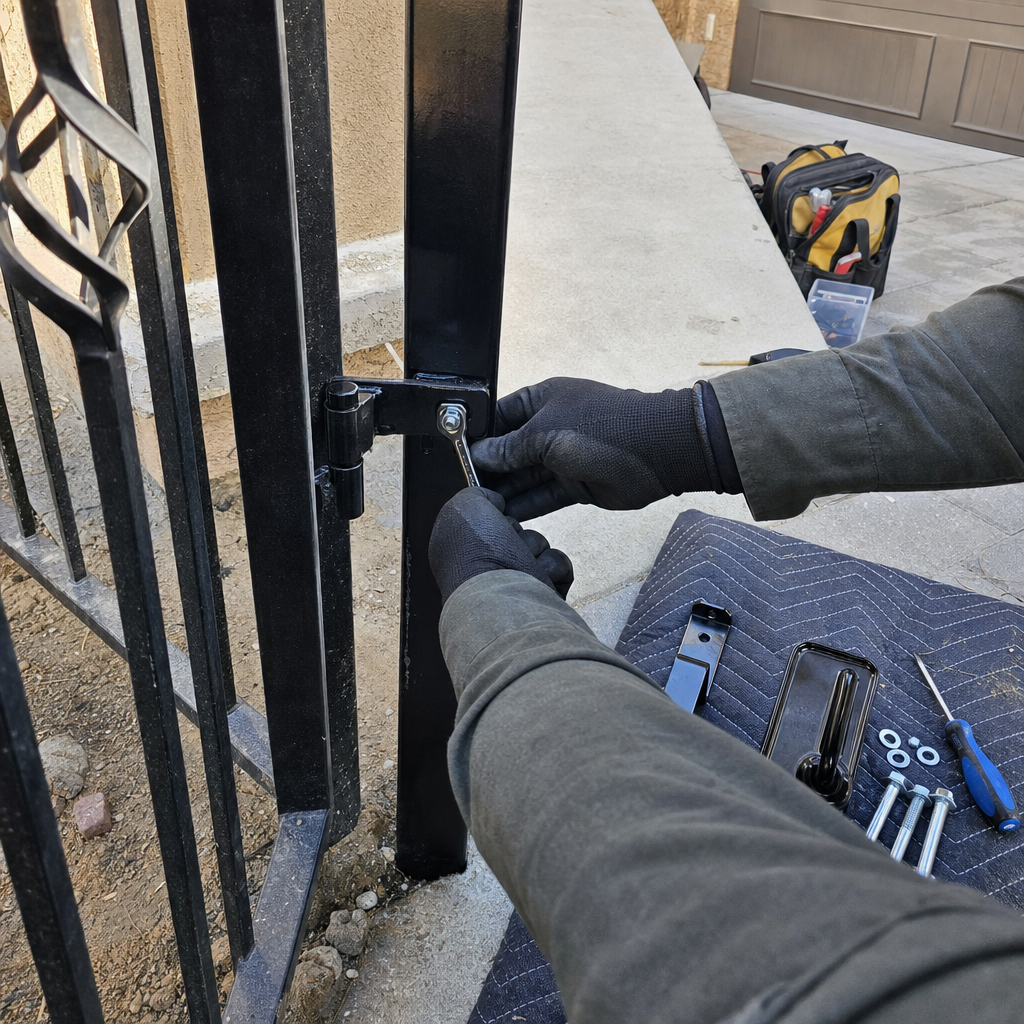
- Hinge mounting plates: The welds attaching hinge plates to the gate frame and to the post carry the full weight of the gate on every cycle. Look for rust staining that follows a line (a sign of water wicking into a crack), paint bubbling along a seam, or any visible gap in the weld bead.
- Drive arm and operator bracket connection: The bracket that mounts your Linear, Viking, or Elite operator to the gate post is welded or bolted. Check for weld cracks where the bracket meets the post, and check for elongated bolt holes that indicate the connection has been flexing.
- Gate frame corner joints: Corners take the most racking stress. Run your fingernail along each interior corner weld — a smooth, continuous bead is fine; a catch or visible gap needs attention.
- Bottom rail and ground clearance points: The bottom rail of swing and slide gates contacts debris and the ground repeatedly. Welds here corrode fastest. Look for rust blistering or black staining that indicates active oxidation beneath the surface.
What to Do If You Find a Crack
Don’t operate the gate if you find a structural weld crack at a hinge or drive arm connection. A gate that’s cycling on a cracked hinge weld can fail catastrophically, and the repair cost escalates significantly once a partial crack becomes a full separation. Paint over the area with a rust-inhibiting primer to slow corrosion and call for a structural assessment. Jonathan Gonzales carries welding equipment on service calls — weld repairs and fabrication happen in a single visit, not after a separate subcontractor appointment.
Monthly, Quarterly, and Annual Task Breakdown
Use this as a printable checklist. Frequency is calibrated for Las Vegas conditions — not national averages. For more guides & resources, explore our blog.
Monthly Tasks
- ☐ Wipe photocell lenses clean with a dry microfiber cloth — both sender and receiver
- ☐ Visually inspect gate for visible obstructions in the travel path
- ☐ Test manual release function (confirm gate opens manually without power)
- ☐ Clear control board vents of visible dust accumulation with compressed air
- ☐ Listen for new grinding, clicking, or hesitation sounds during full cycle
- ☐ After any monsoon event: full post-storm inspection per the checklist above
Quarterly Tasks
- ☐ Clean and re-lubricate all hinge joints and pivot points using desert-rated grease
- ☐ Inspect drive chain or belt tension — adjust per operator manual if slack exceeds 1/2 inch
- ☐ Check all mounting hardware (bolts, nuts, anchor plates) for looseness from vibration
- ☐ Test safety reverse function — place a 2×4 flat on the ground in the gate path and confirm auto-reverse triggers
- ☐ Inspect control board for signs of insect nesting (scorpions, ants, and wasps are regular visitors in Las Vegas gate boxes)
- ☐ Test all remote controls and keypads — replace batteries in remotes showing range reduction
Annual Tasks
- ☐ Battery backup capacity test (schedule for May — before heat season peaks)
- ☐ Full weld-point visual inspection per the checklist above
- ☐ Motor brushes and capacitor check on older AC operators (operators over 7 years old)
- ☐ Full access control audit: delete stale codes, re-program current users, update any DoorKing or Linear system firmware if applicable
- ☐ Gate post base inspection for caliche accumulation and ground-level corrosion
- ☐ Inspect all weatherstripping and gate seals for UV cracking — Las Vegas UV index destroys rubber and vinyl seals in 18–24 months
- ☐ Measure and document gate travel speed and compare to prior year — slowing cycle time is an early motor wear indicator
Brand-Specific Notes: LiftMaster, FAAC, BFT, and Others in Las Vegas
No two gate operators age exactly the same way in Las Vegas conditions, and we work on all of them — LiftMaster, FAAC, BFT, Linear, Viking, Ghost Controls, DoorKing, Elite, and Mighty Mule — which means we see the failure patterns specific to each brand in this climate.
- LiftMaster: The most common brand in residential Las Vegas communities. The RSL12V and LA400 models are workhorses, but their battery backup compartments trap heat. Check the battery compartment seal annually — they crack in UV exposure and allow dust intrusion directly onto the board.
- FAAC and BFT: Italian-engineered operators with excellent thermal management, but their hydraulic units can develop seal weeps when cycling through extreme Las Vegas temperature ranges. If you see oily residue around the operator housing, the hydraulic seal is the first thing to check — not the motor.
- Ghost Controls and Mighty Mule: Budget-tier solar gate operators common on rural Las Vegas perimeter properties. Their solar panels degrade significantly faster in desert UV conditions. If your Ghost Controls unit is cycling sluggishly in July despite full sun, the solar panel output has likely dropped, not the motor. Test panel output with a multimeter before assuming motor failure.
- DoorKing: Commercial-grade access control units found frequently in apartment complexes and HOA entry systems across Las Vegas. Their telephone entry boards are susceptible to voltage spikes during monsoon lightning. A surge protector on the incoming power line is not optional — it’s essential maintenance for any DoorKing installation.
- Viking and Elite: Commercial slide gate operators commonly installed on industrial and warehouse properties. Their drive gear assemblies require more frequent lubrication intervals in dusty Las Vegas environments than the manufacturer’s standard recommendation — we suggest every 60 days rather than every 90.
If you’re unsure what brand or model you have, we can identify it on-site. We work with all nine brands listed above and carry parts inventory for the most common models.
Common Mistakes to Avoid
- Lubricating before cleaning. In Las Vegas dust conditions, applying grease to a dirty joint creates an abrasive compound. Always clean fully before any lubrication — this is the single most common self-maintenance error we see.
- Ignoring battery backup until power fails. By the time your gate won’t open during an outage in August, the battery has already been heat-damaged for months. Test capacity every May, before summer heat peaks — not in September after the damage is done.
- Using light spray lubricants on high-load joints. WD-40 and similar spray lubricants are penetrants, not long-term lubricants. In Las Vegas summer heat, they evaporate within weeks. Use white lithium or marine-grade grease on hinge barrels, pivot pins, and roller bearings.
- Restoring power after monsoon moisture intrusion. If your control box shows any sign of water entry after a storm, don’t power the system back on immediately. A wet circuit board will short on power restoration. Dry it completely — at least 24 hours with desiccant — before testing.
- Skipping the weld inspection because the gate “looks fine.” Weld cracks develop over months and are invisible to a casual glance. A gate that operates smoothly can have a hinge weld that’s 80% cracked. Run your fingernail along every weld seam annually — you’ll feel a gap before you see one.
- Assuming a slow gate means a dying motor. In Las Vegas, a gate that’s slowing down is far more likely to have a track debris problem, a binding hinge, or a low backup battery affecting performance than an actual motor failure. Diagnose before you replace.
- Ignoring insect nesting in control boxes. Ant colonies and wasp nests inside gate operator housings are not rare in Las Vegas — they’re routine. An ant colony shorting out a control board looks exactly like an electrical failure. Open the housing and inspect before assuming board failure.
When to Call a Professional
Handle the cleaning and visual checks yourself — that’s what this guide is for. But call a technician when: (see How to Hire a Gate Repair Contractor in Las Vegas: A Step-by-Step Guide for vetting tips)
- You find a crack in any weld point on the hinge plates, drive arm bracket, or gate frame corners
- The gate reverses unexpectedly mid-cycle even after photocell cleaning and alignment
- Your backup battery fails the cycle test and the housing shows signs of corrosion or moisture
- The motor runs but the gate doesn’t move — or moves and then skips
- You see moisture inside a sealed FAAC or BFT hydraulic housing
- The control board shows burn marks, insect nesting, or corrosion you can’t safely address yourself
- Your access control system (DoorKing, Linear, or similar) stops accepting valid credentials after a storm
Pro Gate Repair Solutions IN Las Vegas offers free estimates in Las Vegas — Jonathan Gonzales personally leads service calls and carries parts and welding equipment on every visit. Call (725) 237-8492 to schedule.
Frequently Asked Questions
How often should I lubricate my gate in Las Vegas?
In Las Vegas, lubricate hinge joints, rollers, and pivot points every 90 days — not twice a year as most generic guides suggest. Desert dust infiltrates lubricated joints within weeks, and summer heat accelerates lubricant evaporation. Always clean the joint thoroughly before applying fresh lubricant, and use a desert-rated grease rather than a spray lubricant. If you notice grinding or resistance before your 90-day interval, don’t wait — clean and re-lubricate immediately.
Why does my gate work fine in spring but fail in August?
The most common cause is battery backup failure from thermal stress. In Las Vegas, gate operator housings can reach internal temperatures above 130°F in July and August, which dramatically accelerates lead-acid battery discharge and capacity loss. A backup that tested healthy in April may have lost 40–50% of its usable capacity by August. Test your backup battery every May before peak heat arrives. Call (725) 237-8492 if you’d like a professional battery assessment.
What should I check after a monsoon storm in Las Vegas?
After any significant monsoon event, inspect the gate track for caliche debris and clear it before operating the gate under power. Check the control box housing for moisture intrusion — if you see condensation on the board, do not restore power until it’s fully dry. Re-check photocell alignment, which monsoon winds can shift on older mounting posts. Also perform a quick weld-point scan, since storm vibration and temperature swings accelerate existing micro-cracks.
How long do gate backup batteries last in Las Vegas heat?
Realistically, 2–3 years for residential systems in Las Vegas — significantly shorter than the 4–5 year ratings manufacturers publish for temperate climates. Extreme heat is the primary factor shortening battery life. Smaller batteries found in Ghost Controls and Mighty Mule solar gate systems tend to degrade even faster. Replace proactively at the 2-year mark if your gate is on a security-critical entrance.
Can I inspect my gate’s welds myself, or do I need a professional?
Homeowners can and should perform a basic weld-point visual inspection annually — run your fingernail along the weld bead at all hinge plates, drive arm brackets, and frame corners, feeling for gaps, and look for rust staining that follows a line. What you shouldn’t do is operate the gate if you find a crack at a structural connection point, or attempt to re-weld without proper equipment. Jonathan Gonzales carries welding equipment on every service call, so structural weld repairs are completed in a single visit. If you spot something concerning, call (725) 237-8492 before the crack progresses.
Do I need different maintenance for slide gates vs. swing gates in Las Vegas?
The core cleaning and lubrication principles are the same, but slide gates have additional track and roller maintenance requirements that are especially relevant in Las Vegas. Caliche debris from monsoon runoff packs into slide gate tracks and can stop the gate completely or force the motor to overload trying to push through it. Slide gate tracks should be swept monthly and inspected after every monsoon event. Swing gates are more exposed to weld stress at the hinge points due to their cantilevered weight, making weld inspections particularly important for heavy iron swing gates common in Gate Repair in North Las Vegas properties.
The Bottom Line
A gate maintenance checklist that wasn’t written for Las Vegas conditions will leave you unprepared for the three failure categories that account for the majority of desert gate breakdowns: dust infiltration into lubricated joints, heat-accelerated battery degradation in August, and post-monsoon debris and moisture damage. Before starting major work, review Gate Repair Permits, Codes & Inspections in NV: What You Need to Know. Use the monthly, quarterly, and annual task breakdown in this guide as your actual maintenance calendar. Inspect weld points annually with your own hands — it takes ten minutes and can prevent a structural failure. And when you find something beyond a cleaning and lubrication task, call a specialist who knows the brands, carries the parts, and can weld on-site. That’s the difference between a same-day fix and a week-long wait for a subcontractor.
For gate repair, Gate Installation in North Las Vegas, or any service from motor replacement to access control programming, call Pro Gate Repair Solutions IN Las Vegas at (725) 237-8492. Jonathan Gonzales handles service calls personally — you get the most experienced person in the company, on your property, with the tools to diagnose and fix it the same day. For Gate Motor & Opener in North Las Vegas service or any operator issue, the same number reaches us directly. Estimates are free.
Written by Jonathan Gonzales, Owner & Lead Technician at Pro Gate Repair Solutions IN Las Vegas, serving Las Vegas since 2022.